| 7,000+ Reviews
 Free EU Shipping above 100€*
 400,000+ Customers Worldwide
 Worldwide Tracked Shipping


3 fundamentals to understand before training abs on a pull-up bar
Many athletes skip straight to leg raises without paying attention to their hanging posture. The result: it's the hip flexors doing the work, not the abs. Here are the three essentials to nail down first.
Grip: the basics
Before even thinking about your abs, focus on your grip. If your hands give out after 5 reps, your ab set won't last very long.
Use a pronated grip (palms facing away), slightly wider than shoulder width. Your thumbs should wrap around the bar (no suicide grip without thumbs). The stronger your grip, the more you can focus on contracting your abs instead of fighting to stay on the bar.
If grip strength is a limiting factor, use chalk or grip tape to improve your hold. You can also build your grip progressively with timed hanging exercises - it's an investment that will make all your hanging ab work far more effective.
Active hang: building the right foundation
The classic mistake: dangling from the bar like a dead weight, shoulders completely relaxed, arms fully extended. That's a passive hang, and it's the best way to stress your joints without engaging your abs.
An active hang means pulling your shoulder blades slightly down and back, as if you were tucking them into your back pockets. Your shoulders drop, your torso locks in, and your whole body stabilizes.
The result: you create a rigid base from which your abs can work effectively. Without this activation, knee raises and leg raises mainly target the psoas. Practice holding this position for 20 to 30 seconds before moving on to exercises. This step is non-negotiable.

Posterior pelvic tilt: the secret to actually engaging your abs
This is THE concept most people overlook - and yet it's what makes all the difference between an effective ab exercise and a movement that just tires out your hips.
A posterior pelvic tilt means tilting your pelvis backward, bringing your pubic bone toward your belly button. Imagine trying to flatten your lower back against an invisible wall. When hanging, this tilt forces your rectus abdominis (the six-pack muscle) and your transverse abdominis to truly contract.
In practice, on every pull-up bar ab exercise, think about "curling" your pelvis upward at the top of the movement rather than just raising your legs. This subtle shift turns a simple knee raise into an exercise that genuinely fires up your entire core.
The 8 best pull-up bar ab exercises
Here are the most effective movements for sculpting your abs while hanging. They're listed in order of increasing difficulty so you can progress intelligently.
Hanging knee raises
This is the foundational movement, perfect for getting started with pull-up bar abs. Hang in an active position, then bring your knees toward your chest while exhaling. The goal isn't just to lift your knees - it's to curl your pelvis at the top of the movement to fully engage the rectus abdominis.
Key points:
- Control the descent (2-3 seconds on the eccentric phase)
- Avoid swinging — if you're swaying, reduce the range of motion
- Aim for 3 sets of 10 to 15 reps
This is a fundamental movement that lays the groundwork for every exercise that follows. Master it completely before moving on. You want to know exactly how to perform Hanging Knee Raises correctly? Here’s a blog with all the details.
Alternating knee raises
This variation adds stabilization and coordination to the classic movement. Instead of raising both knees at the same time, you alternate: one knee comes up while the other stays low.
This unilateral movement forces your obliques and deep stabilizers to work hard to prevent your body from rotating. It's also an excellent way to build ab endurance, since time under tension is doubled compared to the standard raise.
Key points:
- Keep your torso as still as possible
- Raise each knee to at least hip height
- Aim for 3 sets of 10 to 12 reps per side
Leg raises
Time to level up by straightening your legs. This simple change dramatically increases the lever arm, requiring much more abdominal strength to control the movement.
Hang in an active position, then raise your straight legs in front of you to about 45 degrees. Focus on your ab contraction rather than how high your feet go. If you feel your lower back arching, you're going too high for your current level.
Key points:
- Point your toes to maximize muscle engagement
- Slow, controlled descent
- Aim for 3 sets of 8 to 12 reps
Want to learn how to perform Leg Raises correctly and get the most out of the exercise? Check out our detailed blog here.

90° straight leg raises
Same principle as above, but you raise your legs to a full horizontal position (90° angle with your torso). This pull-up bar ab exercise demands both core strength and hamstring flexibility.
The difficulty ramps up significantly in the second half of the movement, between 45° and 90°. This is the zone where your abs work the hardest. Make sure to keep your posterior pelvic tilt active throughout to prevent the hip flexors from taking over.
Key points:
- Never let your legs drop suddenly on the way down
- Hold for 1-2 seconds at the top
- Aim for 3 sets of 8 to 10 reps
Strict toes-to-bar: the king of all moves
The strict toes-to-bar is widely considered the king of hanging ab exercises, and that for good reason. It demands serious core strength, solid mobility and total control over the movement.
The concept is straightforward: bring your toes to the bar, legs straight, with absolutely no kipping (momentum). The entire movement is powered by your core contraction. If you can't do it strict yet, use the progression from 90° leg raises.
Key points:
- The movement starts from the abs, NOT from hip momentum
- Full control on the way up and down
- Aim for 3 sets of 5 to 8 reps

Lateral knee raises to target the obliques
Your obliques deserve just as much attention as the rectus abdominis. Lateral knee raises are the ideal exercise for targeting them directly on your pull-up bar.
The movement is similar to a standard knee raise, except you direct your knees to one side on each rep, alternating right and left. This lateral rotation intensely engages the internal and external obliques.
Key points:
- Raise your knees to at least hip height
- Focus on exhaling during the lateral contraction
- Aim for 3 sets of 8 to 12 reps per side
Windshield wipers: controlled rotation
This is one of the most impressive and demanding ab exercises out there. Windshield wipers combine raw rectus abdominis strength with rotational oblique power.
Raise your straight legs up to the bar (toes-to-bar position), then swing your legs from side to side like windshield wipers, keeping your upper body as stable as possible. Your grip, shoulders and abs work in synergy to control the range of motion.
Key points:
- Start with a reduced range of motion and increase gradually
- Keep your legs together and straight
- Aim for 3 sets of 6 to 10 reps (total, not per side)
This exercise is reserved for athletes who have already mastered strict toes-to-bar. Don't skip steps.

Hanging L-sit
The hanging L-sit is a formidable isometric exercise. No reps here: you hold a static position with your legs straight out at horizontal while hanging from the bar.
This hold recruits your rectus abdominis, transverse abdominis, hip flexors and quads in constant contraction. It's an excellent indicator of your overall core strength and a signature calisthenics movement.
Key points:
- Push the bar down with your hands to engage your lats
- Toes pointed, legs perfectly horizontal
- Aim for 3 sets of 15 to 30 seconds
If you can't hold it for 10 seconds, start with a bent-knee L-sit and gradually straighten your legs over the following weeks.
Progression chart by level: from beginner to advanced
Here's a summary to help you identify where each exercise sits according to your level and progress smartly through your pull-up bar ab exercises:
| Level | Exercise | Sets × Reps |
|---|---|---|
| Beginner | Hanging knee raises | 3 × 12-15 |
| Beginner | Alternating knee raises | 3 × 10-12/side |
| Intermediate | Leg raises | 3 × 8-12 |
| Intermediate | 90° straight leg raises | 3 × 8-10 |
| Intermediate | Lateral knee raises | 3 × 10-12/side |
| Advanced | Strict toes-to-bar | 3 × 5-8 |
| Advanced | Windshield wipers | 3 × 6-10 |
| Advanced | Hanging L-sit | 3 × 15-30s |
Only move to the next level once you've fully mastered the previous movement with total control and no swinging.
2 ready-made pull-up bar ab workouts (10-15 min)
No more thinking. Here are two plug-and-play sessions to integrate pull-up bar ab training into your routine.
Workout A – beginner / intermediate
| Exercise | Sets × Reps | Rest |
|---|---|---|
| Hanging knee raises | 3 × 12 | 45s |
| Alternating knee raises | 3 × 10/side | 45s |
| 90° straight leg raises | 3 × 8 | 60s |
| Bent-knee L-sit hold | 3 × 15s | 45s |
Estimated duration: 10-12 minutes. Perform this workout 2 to 3 times per week at the end of your training session.
Workout B – intermediate / advanced
| Exercise | Sets × Reps | Rest |
|---|---|---|
| Strict toes-to-bar | 4 × 6 | 60s |
| Windshield wipers | 3 × 8 | 75s |
| Lateral knee raises | 3 × 10/side | 45s |
| Hanging L-sit | 3 × 20s | 60s |
Estimated duration: 12-15 minutes. Ideal for athletes who have already mastered strict leg raises.

How to breathe properly during hanging ab exercises
Breathing is an often-overlooked detail, but it has a direct impact on your ab contraction and performance.
The rule is simple: exhale on the effort (when you raise your legs or knees) and inhale on the return (lowering phase). This isn't just about comfort. When you exhale, your ribs drop and your abs naturally contract more intensely. Breathing out fully at the top maximizes transverse abdominis recruitment.
Watch out for the classic trap: holding your breath throughout the movement. Breath-holding creates excessive intra-abdominal pressure and prevents you from sustaining longer sets. Focus on breathing in a fluid, rhythmic pattern, syncing each respiratory phase with the movement.
For isometric exercises like the hanging L-sit, use short, shallow breaths to maintain abdominal tension without releasing your position.
Which pull-up bar to choose for training abs at home?
All the ab exercises in this article require just one piece of equipment: a quality pull-up bar. But you still need to pick the right model based on your space and goals. Here's a comparison of GORNATION options:
| Model | Type | Max load | Best for |
|---|---|---|---|
| Door Pull Up Bar Uni | Wall / Door / Hallway | 150 kg | Getting started with a versatile model |
| Wall-Mounted Pull Up Bar Medium | Wall / Ceiling | 150 kg | Advanced exercises (60 cm wall clearance) |
| Ceiling Pull Up Bar Multi | Ceiling / Wall | 150 kg | Varying grips and angles |
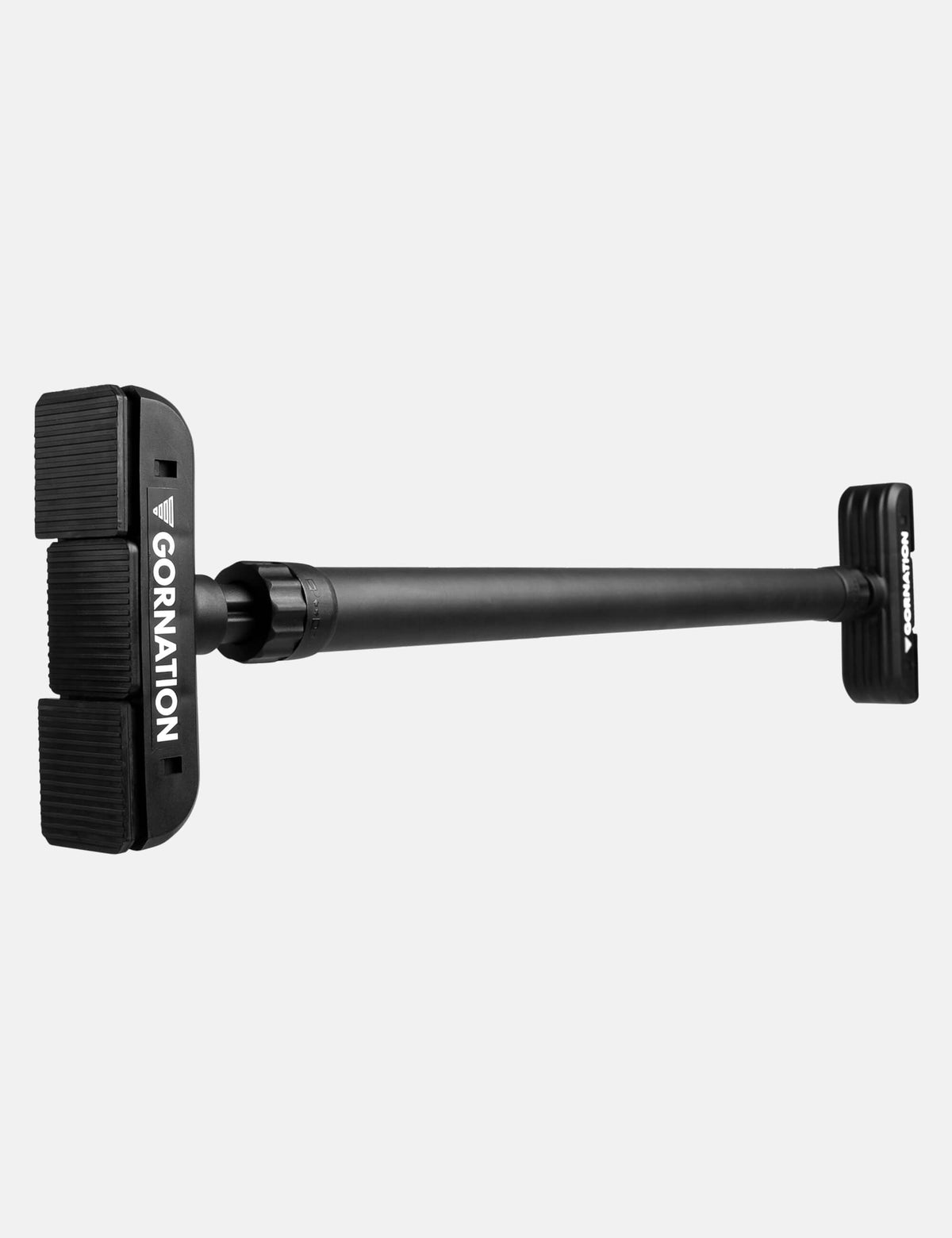
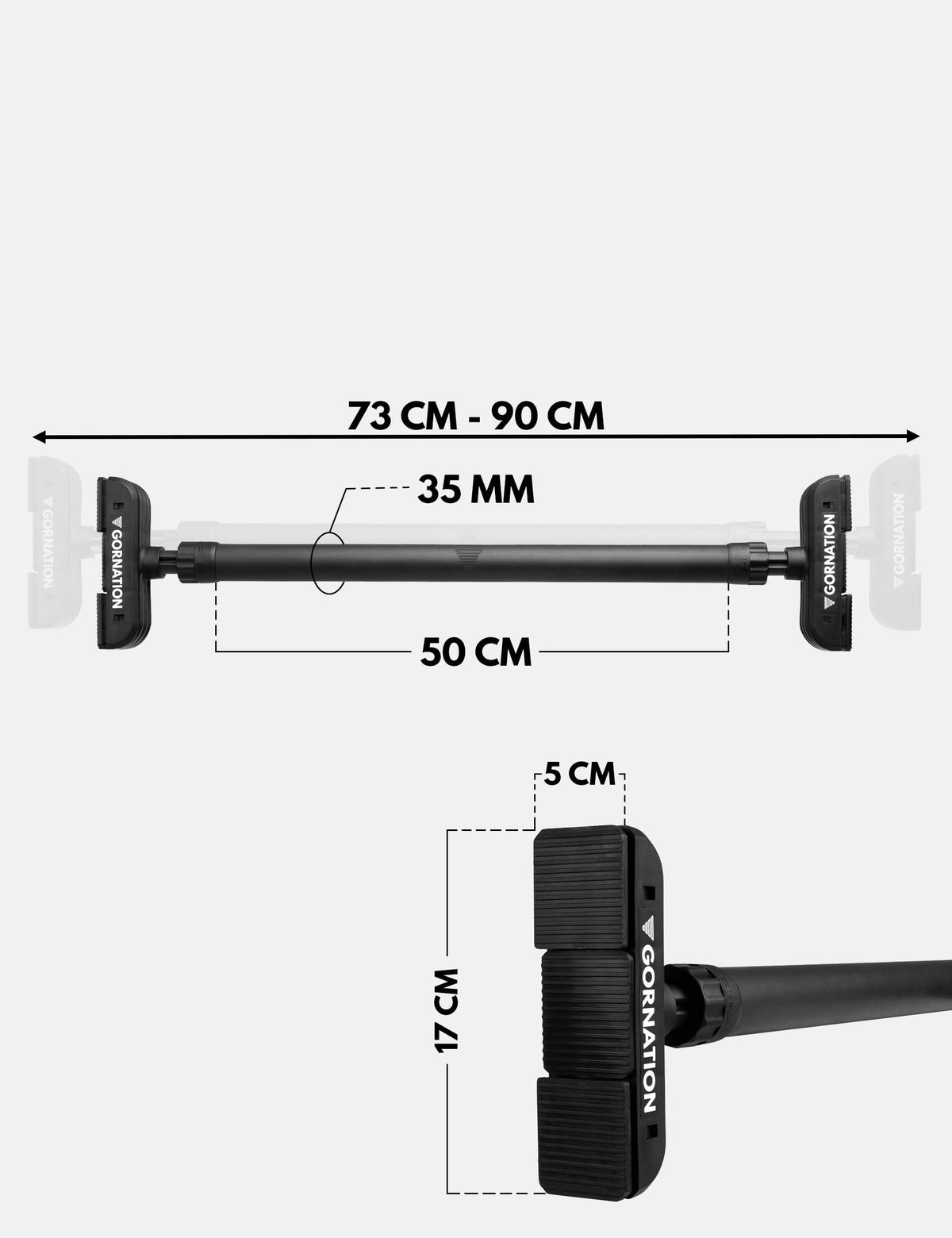
| Extend-it | Doorway (no drilling) | 150 kg | Training without drilling into walls |
| Premium Pull-Up Station | Freestanding | 250 kg | Complete home gym (100+ exercises) |

Doorway bar, wall-mounted bar or pull-up station: which one should you choose?
The choice comes down to three criteria: your available space, your budget and your training level.
Doorway bar (Extend-it or Hook-it): this is the simplest solution. No drilling, set up in seconds. Perfect if you're a beginner or a renter. The Extend-it offers a safe structure with an anti-rotation system. However, wall clearance is limited, which can be an issue for windshield wipers or toes-to-bar.
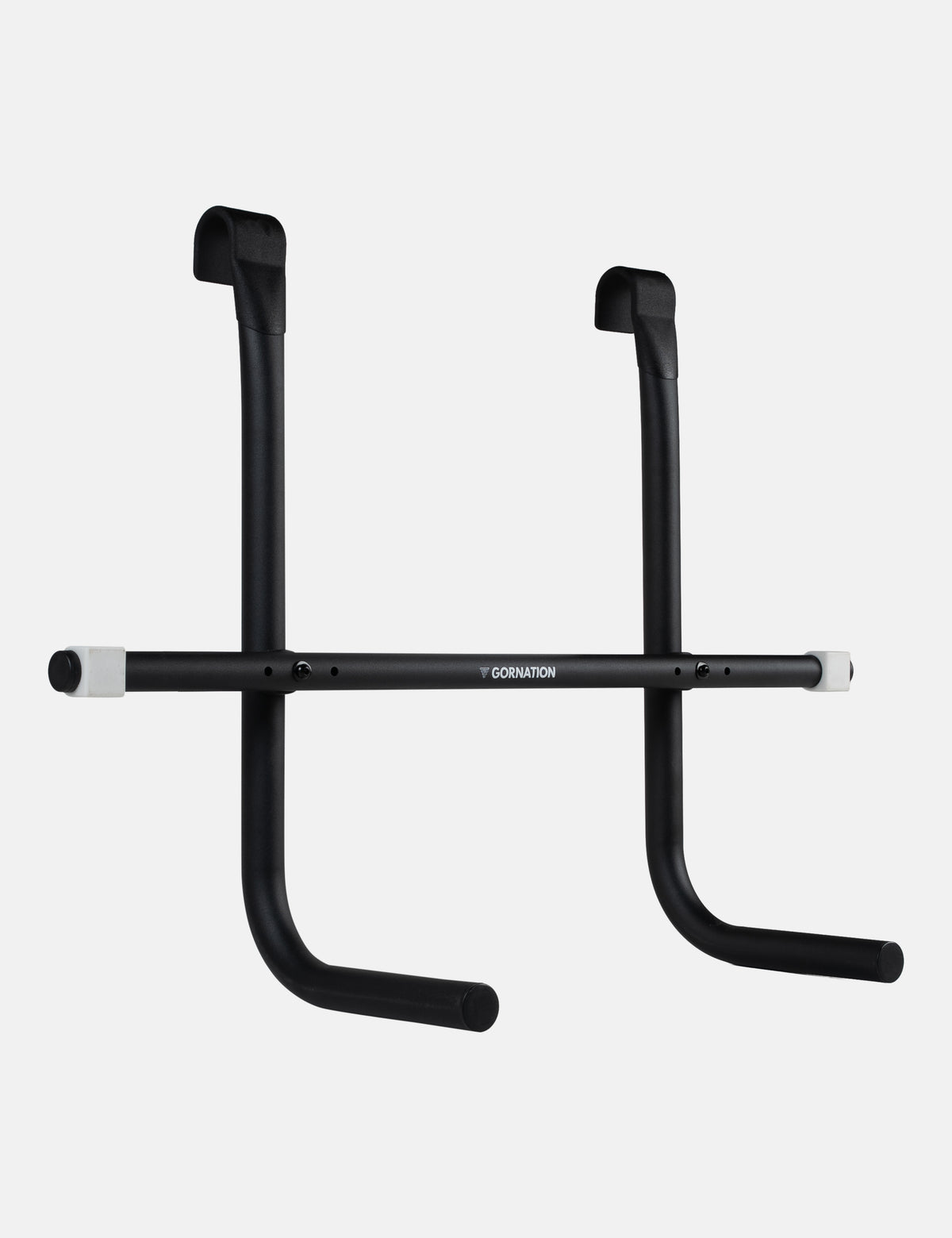
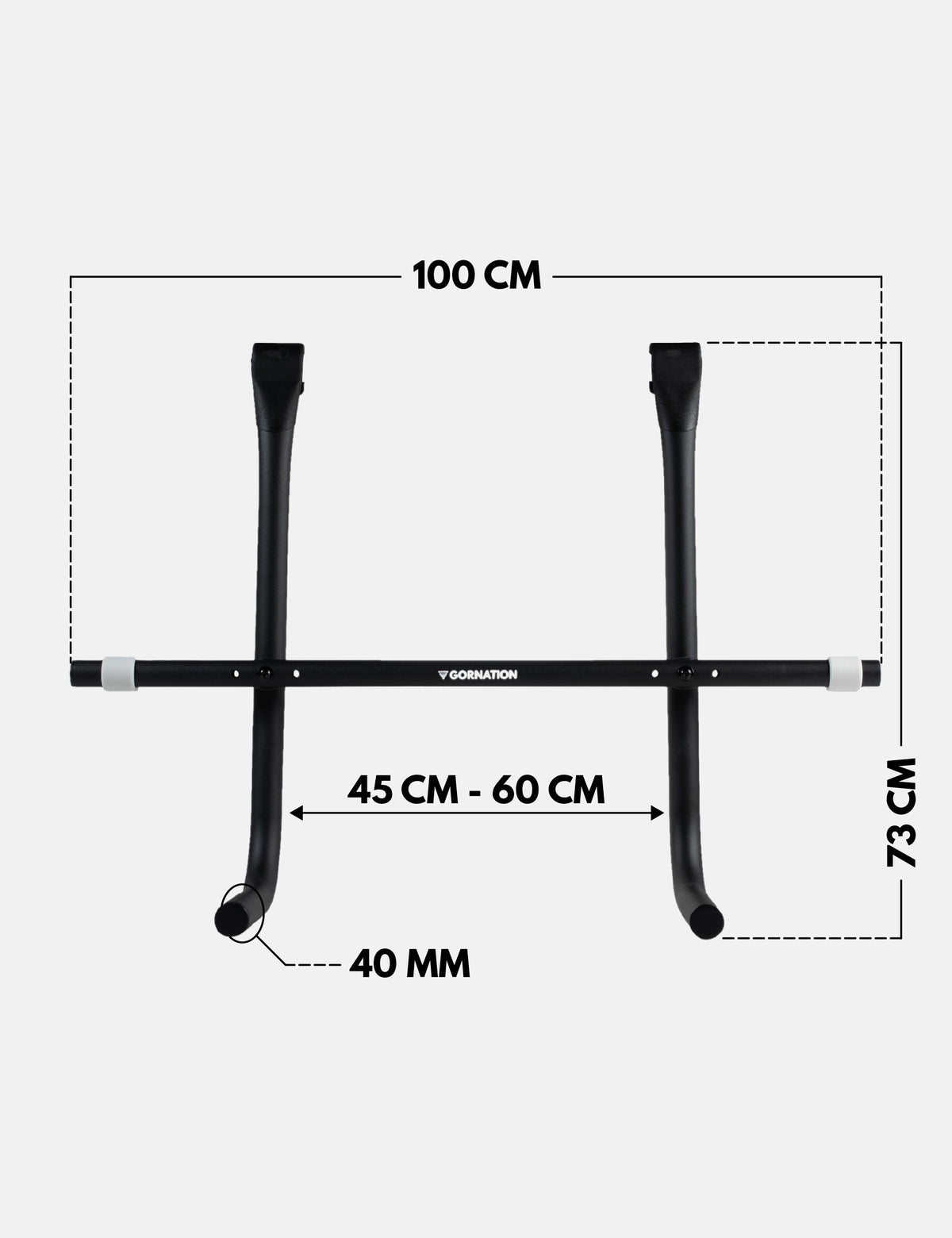
Wall-mounted bar (Door Uni, Medium or Multi): this is the best balance between stability, versatility and footprint. The Wall-Mounted Bar Medium offers 60 cm of wall clearance, which is ideal for leg raises, toes-to-bar and even muscle-ups. If you want to vary your grips, the Multi is designed exactly for that.
Premium Pull Up Station: if you have the space and the budget, the GORNATION Premium Pull-Up Station is a true home gym. Over 100 possible exercises on just 1.5 m², with a 250 kg load capacity. You can perform every ab exercise in this article, plus dips, squats and much more.
5 common mistakes that are holding your abs back (and how to fix them)
1. Using momentum (kipping) instead of strength
If your body is swinging back and forth, it's your hips doing the work, not your abs. Fix this by reducing the range of motion and pausing for one second at the bottom between each rep.
2. Forgetting the posterior pelvic tilt
We said it earlier, but it bears repeating: without tilting your pelvis backward, you're turning your pull-up bar ab exercises into a hip flexor workout. Think "curl" on every rep.
3. Going too fast
Speed is the enemy of ab contraction. Each rep should last at least 3 to 4 seconds (up + down). If you're rushing through them, you're losing 50% of the movement's effectiveness.
4. Neglecting the eccentric phase (lowering)
Most people just drop their legs after the contraction. But the controlled lowering phase is equally effective for building strength. Actively brake the descent over 2 to 3 seconds.
5. Progressing too quickly
Jumping to windshield wipers when you haven't mastered strict leg raises is a recipe for poor form and lower back pain. Stick to the progression chart above.

Pull-up bar abs vs floor abs: what's the real benefit?
The question comes up all the time: why bother training abs while hanging when crunches on the floor work too?
The answer comes down to three points. First, the time under tension is far greater when hanging. Your abs have to stabilize your entire body in mid-air, which recruits more muscle fibers than a simple floor crunch.
Second, hanging exercises work the entire core: rectus abdominis, transverse abdominis, obliques, and even the deep stabilizer muscles. Floor abs, by comparison, mainly target the upper portion of the rectus abdominis.
Third, pull-up bar ab exercises strengthen your grip, scapular stability and functional core strength - qualities that directly transfer to pull-ups, muscle-ups and all calisthenics movements.
That doesn’t mean your training should only include exercises on the pull-up bar. Floor-based movements like hollow body holds and planks are still great for building core strength, and adding different exercises keeps your training more varied and effective. If you want even more inspiration for your workouts, check out our blog with more core exercises here.